Other Articles
- IAM - Enable User MFA
- IAM - Enforce Key Rotation
- IAM - Enforce Active Key Limit
- IAM - Disable Unused User Credentials
- IAM - Enforce Group Permission
- IAM - Enforce Password Length
- IAM - Prohibit Password Reuse
- IAM - Check Root Access Keys Existence
- IAM - Enable Root MFA
- IAM - Establish Support Role
- IAM - Enable Key Rotation
- Purge Expired Certificates
- EC2 Volume – Enable EBS Encryption
- EFS – Enable EFS Storage Backup
- S3 Bucket – Enable S3 Bucket Versioning
- S3 Bucket – Enable S3 Bucket Encryption
- S3 Bucket – Block S3 Bucket Public Access
- RDS DB Instance – Encryption of Storage
- RDS DB Instance – Enable Deletion Protection
- RDS DB Instance – Enable Auto Minor Version Upgrade
- DynamoDB Table – Enable Table Encryption
- DynamoDB Table – Enable Table Point In Time Recovery
- DynamoDB Table – Enable Table Deletion Protection
- EC2 Instance – Monitor CPU Utilization
- ECS Service – Monitor CPU Utilization
- ECS Service – Monitor Memory Utilization
- RDS DB Instance – Monitor Free Storage Space
- RDS DB Instance – Monitor CPU Utilization
- SQS Queue – Monitor Message Age
- SQS Queue – Monitor Message Visibility
- DynamoDB Table – Monitor Table Read Capacity
- DynamoDB Table – Monitor Table Write Capacity
- DynamoDB Table – Monitor Table Latency
- Enable CloudTrail
- Encrypt CloudTrail Logs
- EC2 VPC – Ensure Flow Logs are Enabled
- RDS DB Instance – Block Public Access
- EC2 Instance – Enable Deletion Protection
- ECS Service – Enable Auto Scaling
- Enable AWS Security Hub
- Enable GuardDuty
EC2 Volume – Enable EBS Volume Backup
Secure Configuration Checks > AWS
This check ensures that Amazon EBS volumes are backed up using snapshots or AWS Backup. Regular backups help protect against accidental deletion, corruption, or system failures.
Check Details
- Resource: EC2 Volume
- Check: Enable EBS volume backup
- Risk: Data loss due to missing or outdated backups
Remediation via AWS Console
-
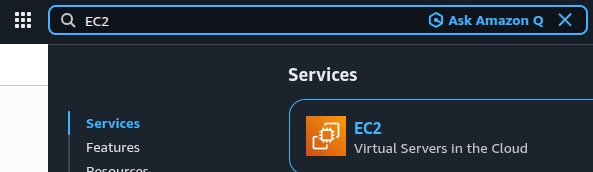
Log in to the AWS Management Console and open the Amazon EC2 console.
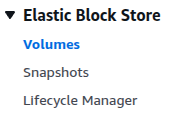
- In the left navigation pane, click Volumes under Elastic Block Store.
-
Select the EBS volume that does not have backup enabled.
-
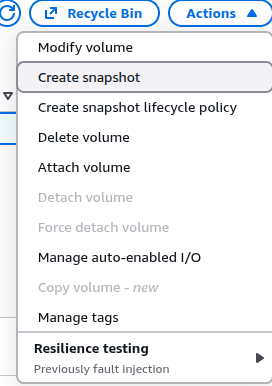
Create a manual snapshot:
- Click Actions → Create snapshot
- Add a description
- Click Create snapshot
-
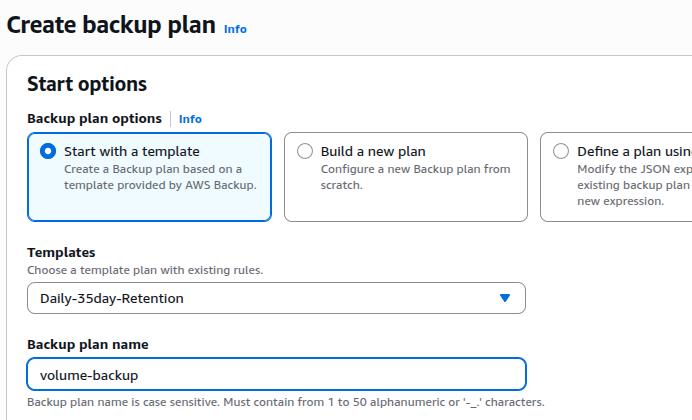
Open the AWS Backup console.

-
Choose Backup plans and click Create backup plan.
-
Add the EBS volume as a resource assignment.
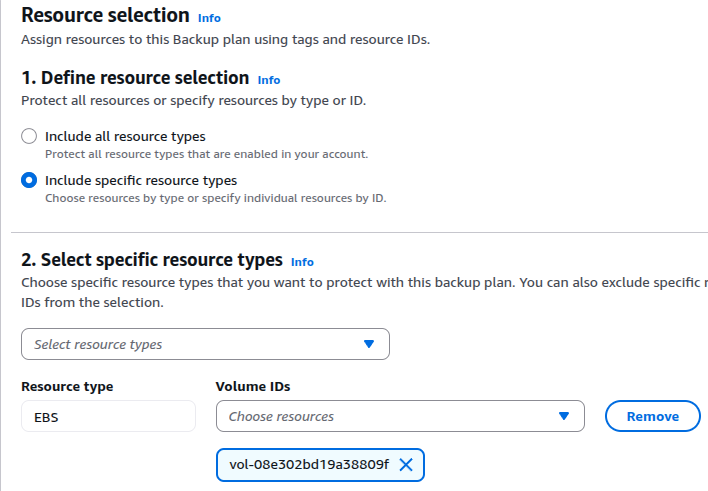
- Save the configuration.
Remediation via AWS CLI
-
Log in to the AWS Management Console and click the CloudShell icon (
>_) in the top-right corner.
-
Create a snapshot of the EBS volume:
aws ec2 create-snapshot --volume-id <volume-id> --description "EBS backup snapshot"
-
Create a backup vault:
aws backup create-backup-vault --backup-vault-name Default
-
Create a backup plan:
aws backup create-backup-plan \ --backup-plan '{ "BackupPlanName": "EBS-Daily-Backup", "Rules": [{ "RuleName": "DailyBackup", "TargetBackupVaultName": "Default", "ScheduleExpression": "cron(0 12 * * ? *)", "Lifecycle": { "DeleteAfterDays": 30 } }] }' -
Assign the EBS volume to the backup plan:
aws backup create-backup-selection \
--backup-plan-id <backup-plan-id> \
--backup-selection '{
"SelectionName": "EBSVolumeSelection",
"IamRoleArn": "arn:aws:iam::<aws-account-id>:role/service-role/AWSBackupDefaultServiceRole",
"Resources": [
"arn:aws:ec2:<region>:<aws-account-id>:volume/<volume-id>"
]
}'
Replace <backup-plan-id>, <aws-account-id>,
<volume-id>, and <region> with actual values.
Updated on 06 March, 2026