Other Articles
- SQL Database – Enable Database Encryption
- SQL Databases – Enable Backup
- SQL Database – Monitor CPU Utilization
- SQL Database – Monitor IO Utilization
- SQL Database – Monitor Memory Utilization
- SQL Database – Protect From Direct Internet Traffic
- SQL Server – Enable SQL Defender
- SQL Server – Require Microsoft Entra-Only Authentication
- SQL Server – Block Public Firewall Rules
- SQL Server – Enable Auditing
- Storage Account – Enable Storage Encryption
- Storage Account – Disable Blob Public Access
- Storage Account – Disable Cross-Tenant Replication
- Storage Account – Disable Public Network Access
- Storage Account – Enable Microsoft Defender
- Storage Account – Enable Secure Transfer
- Storage Account – Enforce Minimum TLS Version
- Storage Account – Enforce Network Access Rule
- Storage Account – Enforce Private Endpoint Access
- Storage Account – Enable Blob Soft Delete
- Storage Account – Enable Blob Versioning
- User – Enable Azure MFA
- App Service – Disable Remote Debugging
- App Service – Enable Defender
- App Service – Enable Entra ID Registration
- App Service – Enable HTTP2
- App Service – Enforce Latest TLS Version
- App Service – Enforce Secure FTPS State
- App Service – Monitor Server Errors
- App Service – Redirect HTTP to HTTPS
- Cosmos DB – Enable Backup
- Cosmos DB – Enable Microsoft Defender
- Cosmos DB – Monitor Latency
- Cosmos DB – Ensure Private Connectivity
- Cosmos DB for PostgreSQL – Monitor CPU Utilization
- Cosmos DB for PostgreSQL – Monitor IO Utilization
- Cosmos DB for PostgreSQL – Monitor Memory Utilization
- Cosmos DB for PostgreSQL – Protect From Direct Internet Traffic
- Cosmos DB – Protect From Direct Internet Traffic
- Cosmos DB – Restrict Firewall Network Access
- Virtual Machine – Enable Defender
- Virtual Machine – Protect From Direct Internet Traffic
- Key Vault – Enable Defender
- Key Vault – Ensure Vault Recoverable
- Key Vault – Require Private Endpoint Access
- Key Vault – Enforce Keys Expiration
- Key Vault – Enable Purge Protection
- Key Vault – Use Azure RBAC Authorization
- MySQL Flexible Server – Enable Audit Log Events Connection
- MySQL Flexible Server – Enable Audit Logs
- MySQL Flexible Server – Enforce Minimum TLS Version
- PostgreSQL Flexible Server – Configure Log File Retention
- PostgreSQL Flexible Server – Enable Connection Logging
- PostgreSQL Flexible Server – Enable Connection Throttling
- PostgreSQL Flexible Server – Enable Disconnection Logging
- PostgreSQL Flexible Server – Enable Log Checkpoints
- Network Security Group – Ensure Flow Logs Captured
- General – Enable Auto Provisioning Log Analytics
- General – Enable Security Notifications
- General – Set Additional Email Address
- Cosmos DB – Enforce Minimum TLS Version
- Container Instance – Enforce Use of Private Virtual Networks
- Container Instance – Enforce Managed Identity Usage
PostgreSQL Flexible Server – Enforce Minimum TLS Version
Secure Configuration Checks > Azure
This check ensures that an Azure Database for PostgreSQL flexible server requires TLS 1.2 or newer for client connections. Older versions of TLS, such as 1.0 and 1.1, have known weaknesses. If the server still accepts them, an attacker can force a weak connection and read or change the data in transit.
Check Details
- Resource: Azure Database for PostgreSQL flexible server
- Check: Enforce PostgreSQL minimum TLS version (
MinimumTLSVersion) - Risk: Connections that use weak protocol versions can be decrypted or tampered with
Remediation via Azure Portal
-
Log in to the Azure Portal.

-
Navigate to Azure Database for PostgreSQL Flexible Servers and select the affected server.

-
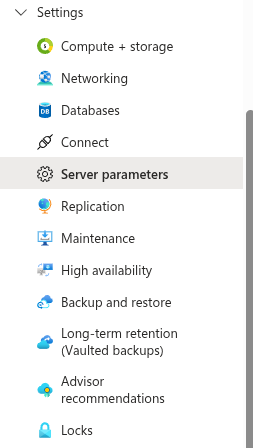
In the left-hand menu, select Server parameters under Settings.
-
Set the value to TLSv1.3.
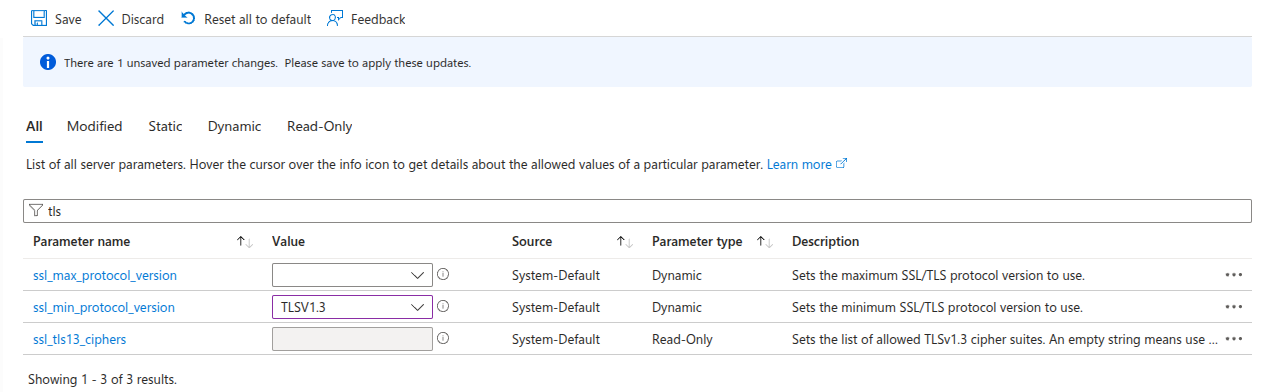
- Click Save. If the portal asks for a restart, confirm it in a maintenance window.
- Repeat steps 2 to 5 for every server that allows an older version.
Remediation via Azure CLI
-
Open Azure Cloud Shell or a local terminal with Azure CLI installed.

-
List the PostgreSQL flexible servers whose minimum TLS version is below 1.2. The output shows the server name and the resource group:
az postgres flexible-server list \
--query "[].[name,resourceGroup]" --output tsv | \
while read name rg; do
  az postgres flexible-server parameter show \
    --resource-group "$rg" --server-name "$name" \
    --name ssl_min_protocol_version \
    --query "value" --output tsv | \
  grep -qixE 'TLSv1.2|TLSv1.3' || echo "$name $rg"
done
The command covers the current subscription. To check another, run
az account set --subscription <subscription-id>first. -
Set the minimum TLS version to 1.3:
az postgres flexible-server parameter set \
--resource-group <resource-group> \
--server-name <server-name> \
--name ssl_min_protocol_version \
--value TLSv1.3
-
Verify the setting:
az postgres flexible-server parameter show \
--resource-group <resource-group> \
--server-name <server-name> \
--name ssl_min_protocol_version \
--query "{Name:name, Value:value}" \
--output table
The value must be
TLSv1.2orTLSv1.3.
Replace <resource-group> with the resource group of the server, for example rg-prod-data.
Replace <server-name> with the name of the PostgreSQL flexible server, for example prod-postgres-server.
Use TLSv1.3 instead of TLSv1.2 only if every client supports it.
Repeat steps 3 and 4 for each server that step 2 lists.
Updated on 06 November, 2026