Other Articles
- Secure AWS Deployments with OIDC
- Build Secure Network Subnet Topology
- Instance/Host Roles in AWS
- Enable AWS GuardDuty for Threat Detection
- AWS CloudTrail: API Logging and Activity Monitoring
- Restricting SSH Access on AWS Using IP Whitelisting
- GitHub – Enabling and Managing Dependabot Scans
- Removing Default VPCs and Blocking Their Recreation with an AWS SCP
Data Protection Using Envelope Encryption
Overview
Envelope encryption is a data protection technique that uses multiple layers of encryption to secure sensitive data efficiently and at scale.
It separates data encryption from key management by using different keys for encrypting data and protecting those keys.
This approach is widely used across cloud platforms and enterprise systems to ensure scalable and secure data protection.
What is Envelope Encryption?
Envelope encryption is a method where data is encrypted using a data encryption key (DEK), and the DEK itself is encrypted using a master key, also known as a key encryption key (KEK).
This layered encryption model enhances security by reducing direct exposure of sensitive keys while maintaining efficient data encryption.
Key Components
- Data Encryption Key (DEK): Used to encrypt the actual data
- Key Encryption Key (KEK): Used to encrypt the DEK
- Encrypted Data: The protected application data
- Encrypted DEK: The secured version of the data key
How Envelope Encryption Works (Ex - AWS)
- A data encryption key (DEK) is generated using a secure key management service
- In AWS, this is handled by AWS Key Management Service (KMS)
- The DEK is used to encrypt the actual data (e.g., files, database records)
- The DEK is then encrypted using a master key (KEK) managed by KMS
- Both the encrypted data and encrypted DEK are stored together (e.g., in Amazon S3 or databases)
- During decryption, KMS first decrypts the DEK
- The decrypted DEK is then used to decrypt the original data
AWS Envelope Encryption Architecture
AWS Envelope Encryption is a secure data protection approach where data is encrypted using a data key, and the data key itself is encrypted using AWS Key Management Service (KMS).
Step 1: Generate Data Key
AWS KMS generates a data encryption key (DEK). This key is returned in two forms: plaintext (used for encryption) and encrypted (protected using a KMS master key).
Step 2: Encrypt Data
The application uses the plaintext data key to encrypt sensitive data locally without sending the data to AWS.
Step 3: Store Encrypted Data
The encrypted data is stored along with the encrypted data key. The plaintext key is discarded from memory.
Step 4: Decrypt Data Key
When data needs to be accessed, the encrypted data key is sent to AWS KMS for decryption.
Step 5: Decrypt Data
The decrypted data key is used to decrypt the stored data securely within the application.
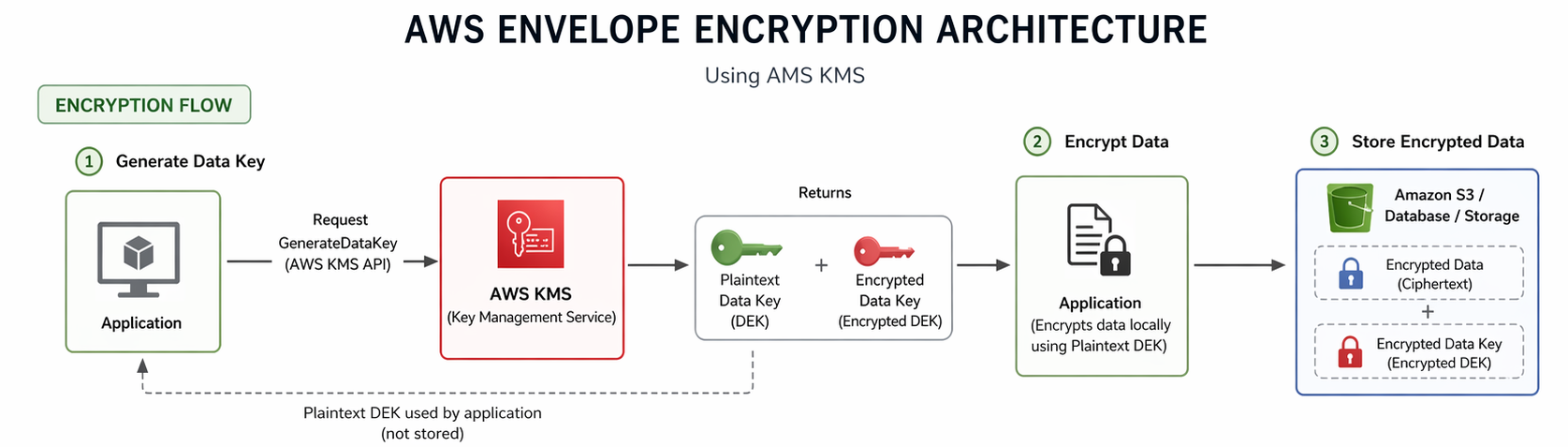
Figure: Envelope encryption uses layered keys to securely protect data and encryption keys.
Where Envelope Encryption is Used
- Cloud storage systems
- Databases and data warehouses
- Backup and archival systems
- Secure file storage and transfer systems
This approach is commonly implemented across modern cloud platforms and enterprise environments to protect data at rest.
Benefits of Envelope Encryption
- Enhanced security through layered encryption
- Reduced exposure of master keys
- Efficient encryption for large-scale systems
- Supports secure key rotation
- Separation of data and key management
Best Practices
- Never store plaintext encryption keys
- Use secure key management systems
- Rotate master keys regularly
- Restrict access to encryption keys
- Enable auditing and monitoring for key usage
Common Mistakes to Avoid
- Storing plaintext keys
- Using a single key for all encryption
- Not rotating keys regularly
- Overly permissive access controls
- Ignoring key usage monitoring
Updated on 24 April, 2026